Request a Quote
Enterprise AI translation workflow combining translation engines, AI post-editing, quality estimation and human review

MTPE, AI Post-Editing & Translation Engine Solutions

A strong translation workflow starts with more than choosing an AI or machine translation engine. Textsprime helps organizations match engines to content, apply business-specific language context, refine output with AI, estimate quality and involve professional linguists where human judgment adds value.

The Translation Engine Is Only the Starting Point

Different content types, language pairs, terminology requirements and quality expectations need different combinations of technology, language context and professional review.

THE BETTER QUESTION
Instead of asking“Which translation engine should we use?”
Ask“Which combination will produce usable content?”
ENGINE-FIRST THINKINGTechnology drives the workflow.
REACTIVE
01
Choose EngineSelect one translation technology.
02
Translate EverythingRoute content through the same approach.
03
Human Fixes ProblemsCorrect issues after they appear.
A BETTER MODEL

Build the workflow around the content—not around one engine.

SOLUTION-FIRST

The Engine Becomes One Part of a Wider Translation System

ADAPTIVE WORKFLOW
PHASE 01
PlanDefine what the content actually needs.
01
Understand ContentAssess purpose, audience, risk and quality expectations.
CONTENT
02
Select EngineMatch technology to language pair, domain and content type.
ENGINE
03
Add Language ContextApply terminology, translation memory, style and reference assets.
CONTEXT
PHASE 02
Generate & RefineCreate and improve the initial translation.
04
Generate TranslationCreate the first machine or AI-generated translation.
GENERATE
05
AI RefineImprove terminology, fluency, tone and consistency.
AIPE

Engine output is not automatically final output.It is one stage in a controlled translation workflow.

PHASE 03
Evaluate & ReviewDecide where additional control is needed.
06
Estimate QualityIdentify output that needs additional refinement or attention.
EVALUATE
07
Review Where NeededApply professional human judgment selectively.
MTPE

Human expertise is focused where judgment, specialist knowledge or risk control adds real value.

THE SHIFT
Translation engineOne technology decision
Translation systemContent + Engine + Context + AIPE + Quality + Human Review

Understand the Role of Each Translation Layer

FOUR-LAYER ARCHITECTUREFrom First Translation to Controlled Output
01Generate
02Refine
03Evaluate
04Verify
LAYERPURPOSEINPUTDECISION
01GENERATE

Translation Engine

Creates the first machine- or AI-generated translation.

MTNMTLLMAI Translation
PURPOSECreate the first translation

Generate an initial target-language version at the speed and scale required by the content.

INPUTSource content + available context

Language pair, content type, domain information and available linguistic context influence the starting output.

DECISIONWhich engine is the best fit?

Select the technology that provides the strongest starting point for this particular content requirement.

───────────────INITIAL TRANSLATION───────────────
02REFINE

AI Post-Editing

Automatically improves the first translation before professional review.

TerminologyGrammarToneStyle
PURPOSEImprove the initial output

Refine terminology, fluency, grammar, tone, consistency and other controllable language characteristics.

INPUTInitial translation + language context

The first translation can be refined using terminology, style guidance, previous translations and contextual rules.

DECISIONWhat can AI improve automatically?

Resolve issues that can be addressed systematically before deciding whether human judgment is necessary.

───────────────REFINED TRANSLATION───────────────
03EVALUATE

Quality Estimation

Evaluates the translation and determines what should happen next.

ConfidenceQuality ScoreRisk FlagsIssues
PURPOSEEvaluate whether more work is needed

Assess translation quality rather than automatically sending every segment through the same review process.

INPUTRefined output + quality criteria

Quality signals, content risk and required standards help identify where additional intervention adds value.

DECISIONPass, refine or review?

Determine which content can continue and which requires further AI refinement or professional human attention.

───────────────SELECTIVE REVIEW───────────────
04VERIFY

Human Review / MTPE

Applies professional linguistic judgment where it is required.

MeaningTerminologyBrandRisk
PURPOSEApply professional judgment

Verify meaning, specialist terminology, tone, brand requirements and content where errors carry greater risk.

INPUTFlagged, specialist or high-value content

Human expertise is concentrated where linguistic judgment or subject-matter knowledge matters most.

DECISIONApprove, correct or feed back

Validate the content while allowing approved corrections to improve future terminology, assets and workflows.

THE SYSTEM LOGICEach layer answers a different question.
01

What should generate the translation?

02

What can AI improve?

03

Does it need more work?

04

Where is human judgment required?

Choose the Right Engine for the Right Content

ENGINE SELECTION MATRIXSix signals shape one technology decision
01–06

Evaluate the content first.Choose the engine second.

01LANGUAGE

Language Pair

Engine performance can vary significantly between different source and target language combinations.

CHECKHow strong is this engine for this language pair?
02DOMAIN

Content Domain

Technical, legal, marketing and support content place different demands on translation technology.

CHECKDoes the engine suit the subject matter?
03CONTEXT

Context

Short interface strings, structured product data and complete documents provide very different levels of context.

CHECKHow much context can the engine actually use?
INPUTContent Requirements
DECISION
BEST-FIT ENGINE

Select the translation technology that provides the strongest starting output for this specific content.

OUTPUTBetter Starting Translation
04CONTROL

Terminology

Product names, technical terms and approved business language may need to be applied with strict consistency.

CHECKCan approved terminology be controlled reliably?
05LANGUAGE

Style

Some content needs direct functional language; other content requires natural tone, brand alignment or tighter stylistic control.

CHECKWhat level of language control does the content need?
06RISK

Risk

Translation errors carry different consequences depending on whether the content affects customers, brand, safety or compliance.

CHECKWhat happens if the starting translation is wrong?
ENGINE SELECTION IS CONTEXTUAL

The goal is not to find the best engine. It is to find the best fit.

01
Different Content

A support article and a brand campaign may benefit from different translation technologies.

02
Different Languages

One engine may perform strongly for one language pair and less effectively for another.

03
Different Requirements

Terminology, style, context and risk can change which technology is the most appropriate starting point.

Give AI the Language Context It Needs

Enterprise language assets providing terminology, translation memory, style guidance and reference context to an AI translation engine
CONTEXT INBETTER STARTING OUTPUT

The engine becomes more useful when it can work with language that has already been approved by your business.

The model provides capability. Your language assets provide direction.

Instead of asking AI to translate in isolation, give it the linguistic context that reflects how your organization already communicates.

01

Terminology

TERM CONTROL

Approved product, technical and business terms help keep important language consistent across translated content.

GIVES AIPreferred language
02

Translation Memory

APPROVED HISTORY

Previously approved multilingual content provides examples of how your organization has translated similar language before.

GIVES AITranslation precedent
03

Style Guidance

LANGUAGE BEHAVIOR

Brand voice, register, tone and writing preferences help shape how the translation should sound—not just what it should mean.

GIVES AIVoice & style
04

Reference Content

DOMAIN CONTEXT

Domain examples and previously validated materials give the translation system additional context for specialist or organization-specific content.

GIVES AIBusiness context
CONTEXT ARCHITECTUREBusiness language becomes translation context.
LANGUAGE ASSETS
TerminologyTMStyleReference
TECHNOLOGYTranslation Engine
OUTPUTContext-Aware Translation

Improve the First Translation Before Human Review

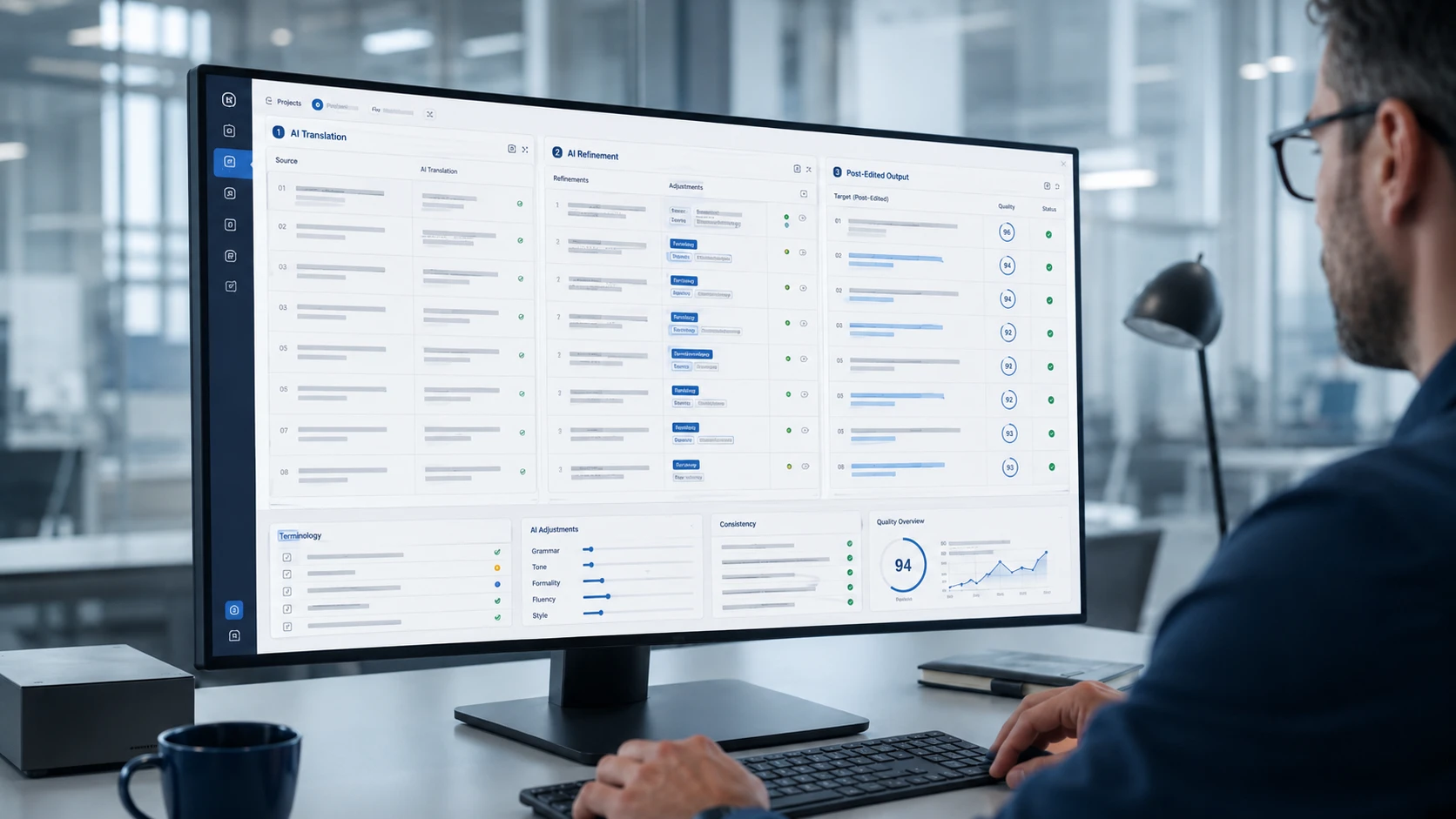
Enterprise AI post-editing workspace showing initial translation, automated language refinement and translation quality indicators
AIPE WORKSPACERefine what can be improved automatically before deciding where human judgment is needed.
TerminologyGrammarFluencyToneStyleConsistency
AIPE IN THE WORKFLOWRefinement sits between generation and quality evaluation.
01
INPUTInitial Translation

First output generated by the selected machine translation or AI engine.

02
REFINEAI Post-Editing

Apply terminology, language rules, style preferences and contextual correction.

03
OUTPUTImproved Translation

A cleaner and more aligned version becomes the next translation candidate.

04
NEXT DECISIONQuality Evaluation

Determine whether the refined output can continue or needs additional review.

01CORRECT

Fix Controllable Language Issues

AIPE can address recurring problems in the initial output before they consume professional review time.

Grammar
Fluency
Formality
02ALIGN

Apply Business Language Context

Refinement can bring output closer to approved terminology, language preferences and organizational standards.

Terminology
Style Guidance
Language Consistency
03REFINE

Improve How the Translation Reads

The resulting translation can be improved for tone, consistency and stylistic fit before further evaluation.

Tone
Style Adherence
Consistency
!
IMPORTANT CONTROL PRINCIPLE

AIPE Improves the Output. It Does Not Automatically Approve It.

AI post-editing is another control layer in the translation workflow—not automatic proof that the translation is ready to publish. The refined output still needs to be evaluated against the quality, risk and business requirements of the content.

NEXT LAYERQuality Estimation
EvaluateRoute

AIPE, MTPE or Human Translation?

START WITH THE CONTENTFive dimensions shape the translation route.
01
RiskWhat happens if the translation is wrong?
02
VisibilityWho will see and use the content?
03
ComplexityHow much linguistic judgment is involved?
04
Quality ExpectationHow refined does the final language need to be?
05
VolumeHow much content must the workflow handle?
CONTENT REQUIREMENTSCHOOSE THE RIGHT LEVEL OF AUTOMATION AND HUMAN CONTROL
DECISION MATRIX

Match the Translation Route to the Content Requirement

TYPICAL FIT
Lower
●●Moderate
●●●Strong
Not Primary
CONTENT REQUIREMENT
01AIPEAutomated refinement
02Human MTPEProfessional post-editing
03Human-LedHuman translation route
01
High-Volume / Low-RiskRepetitive content where scale is a major priority.
●●●Strong fit
Selective
Not primary
02
Internal KnowledgeInternal information where usability and scale matter.
●●●Strong fit
●●As needed
Not primary
03
Product SupportCustomer-help content balancing scale and usability.
●●Useful
●●Useful
Selective
04
Customer-Facing Business ContentVisible content where language quality affects customers.
●●Refinement layer
●●●Strong fit
●●Important
05
Brand-Sensitive ContentContent where tone, voice and brand perception matter.
Supporting role
●●Useful
●●●Strong fit
06
High-Risk Specialist ContentContent requiring greater specialist control and judgment.
Not primary
●●●Strong fit
●●●Strong fit
HOW TO READ THE MATRIXHuman involvement rises as judgment matters more.
SCALEMore Automation

Higher-volume, lower-risk content can place more weight on AI refinement.

AIPEMTPEHUMAN-LED
JUDGMENTMore Human Control

Brand sensitivity, specialist complexity and risk increase the value of professional human judgment.

THE DECISION IS NOT BINARY

The question is not AI or human. The question is where each adds the most value.

Use Quality Estimation to Decide What Needs Review

TRADITIONAL MTPE
1,000
Translated SegmentsAll content enters review.
1,000
Human ReviewsEvery segment receives the same treatment.

Review effort is distributed evenly, regardless of whether every segment presents the same quality or risk.

ROUTE BY QUALITY
QUALITY-BASED WORKFLOW
1,000
Translated SegmentsContent first enters quality evaluation.
QE
Quality EstimationDifferent output can follow different routes.

Review effort is focused on the content where refinement, professional judgment or risk control adds the most value.

QUALITY ROUTING FUNNEL

Evaluate First. Route Second.

Quality estimation becomes the decision layer between translated output and the next action.

INPUT
01
All Translations

Machine- or AI-generated output enters the same evaluation layer before the workflow decides what should happen next.

MT OUTPUTAI OUTPUTAIPE OUTPUT
EVALUATE
02
DECISION LAYER

Quality Estimation

Assess whether the translated output appears suitable to continue, needs further automated refinement, or should be routed to professional review.

01
ConfidenceHow reliable does the output appear?
02
Quality ScoreDoes it meet the required threshold?
03
Risk FlagsCould the content require greater control?
04
Issue DetectionAre there problems requiring intervention?
ROUTING DECISIONWhat does this translation need next?
01HIGH CONFIDENCE

Continue

Output that meets the required quality threshold can continue through the workflow without automatically entering full human review.

ACTIONContinue to delivery or downstream QA
02NEEDS REFINEMENT

Route to AIPE

Output with correctable language issues can receive additional automated refinement before another quality decision is made.

ACTIONRefine terminology, fluency, tone or style
03NEEDS JUDGMENT

Route to Human Review

Flagged, uncertain, specialist or higher-risk content can be routed to professional linguists where human judgment adds greater value.

ACTIONVerify meaning, terminology, brand and risk
SELECTIVE HUMAN REVIEW

Quality Estimation Changes Where Human Effort Is Applied

×
Not: Remove Humans

The purpose is not to assume that automated output no longer needs professional expertise.

Instead: Use Human Review Selectively

Concentrate linguists on the content where uncertainty, complexity, visibility or risk makes their judgment valuable.

Focus Human Expertise Where It Adds the Most Value

Review the Content That Requires Judgment—not Everything by Default

Quality estimation can identify content that deserves closer attention. Professional linguists then focus on the questions that automated refinement cannot reliably answer on its own.

01

Meaning

SEMANTIC JUDGMENT

Does the translation preserve what the source actually intends to communicate?

HUMAN CHECKIntent & nuance
02

Domain

SUBJECT EXPERTISE

Is specialist terminology being used correctly in the context of the subject matter?

HUMAN CHECKTechnical accuracy
03

Brand

LANGUAGE JUDGMENT

Does the translated content sound appropriate for the organization, audience and communication context?

HUMAN CHECKVoice & tone
04

Risk

BUSINESS JUDGMENT

Could an inaccurate or ambiguous translation create a business, legal, safety or customer-facing problem?

HUMAN CHECKConsequences

Human review is not simply another final step. It is a targeted control layer for content where professional judgment materially changes the quality or reliability of the result.

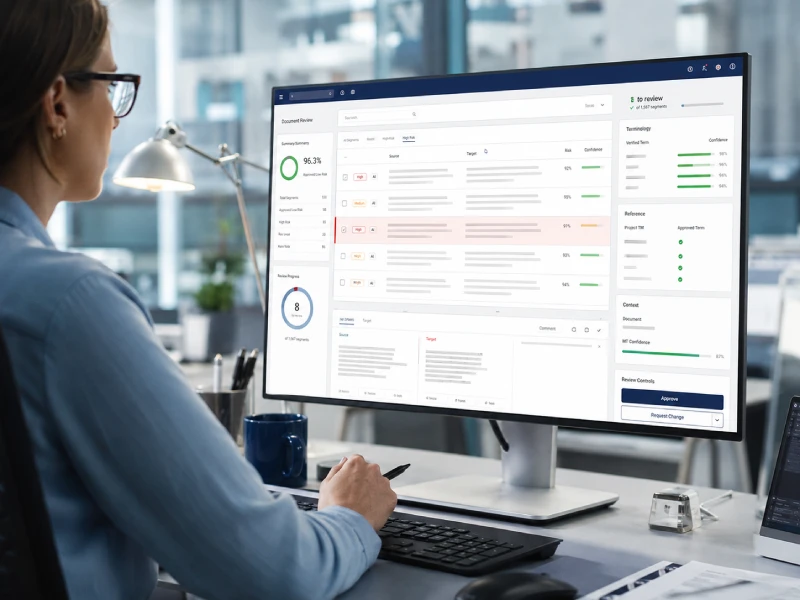
Professional linguist selectively reviewing flagged high-risk AI translation content in an enterprise translation environment
SELECTIVE REVIEWAI handles scale. Experts handle judgment.
HUMAN-IN-THE-LOOP
01
ROUTEDFlagged Content
02
JUDGMENTExpert Review
03
DECISIONApproved Output
WHY HUMAN HERE?

The system can identify where attention is needed. The linguist determines whether the translation is actually right for the intended meaning, subject, audience and level of risk.

WHERE HUMAN EXPERTISE ADDS VALUEJudgment becomes more important as content becomes harder to standardize.
MORE AUTOMATABLEPredictable LanguageRepetitive • Structured • Lower risk
AUTOMATEREFINEEVALUATEHUMAN JUDGMENT
MORE JUDGMENTContext-Sensitive LanguageSpecialist • Visible • Higher risk

Turn Corrections Into Better Future Output

ONE-TIME CORRECTION
01Translate
02Correct
03Deliver

The translation is fixed for the current project, but the knowledge behind that correction may never influence the next translation.

CAPTURE THE LEARNING
CONTINUOUS IMPROVEMENT
Corrections Become Reusable Language Intelligence

Approved decisions feed terminology, language assets and workflow rules that can improve future output.

CLOSED FEEDBACK LOOP

Approved Language Should Keep Working After Delivery

Instead of treating post-editing as an isolated final step, validated corrections become part of the context used by future translation workflows.

VALIDATED LANGUAGE
Approved Translation

The point where reviewed language becomes reusable knowledge instead of a one-time correction.

01
GENERATETranslate

Create the next multilingual output.

02
ASSESSEvaluate

Identify quality issues and uncertainty.

03
JUDGEReview

Apply professional linguistic judgment.

04
CAPTURELearn

Record what the approved correction teaches.

05
APPLYReuse

Feed validated language back into the system.

06
OPTIMIZEImprove

Give future translation a stronger starting point.

WHAT CHANGES?

The Correction Becomes Part of the Translation System

When a linguist approves or changes a translation, the useful part of that decision can be captured and applied beyond the current segment.

01
Capture the Decision

Identify whether the correction reflects terminology, style, context, quality or engine-selection knowledge.

02
Update the Right Asset

Put validated language into the resource where it can influence future work.

03
Reuse It Automatically

Future workflows can begin with stronger context instead of rediscovering the same correction again.

Better review should improve future translation, not just current translation.

WHAT THE FEEDBACK LOOP CAN IMPROVEOne approved correction can strengthen multiple parts of the workflow.
01
Terminology

Record approved product, technical and business terms.

02
Translation Memory

Preserve validated multilingual language for future reuse.

03
Style Guidance

Strengthen tone, register and writing preferences.

04
Prompts & Rules

Improve instructions used during AI translation and refinement.

05
Engine Selection

Learn where a particular engine performs well or poorly.

06
Future QA

Turn recurring issues into stronger quality checks.

WITHOUT FEEDBACKEvery project starts by solving familiar problems again.
APPROVED LANGUAGECapture • Learn • Reuse
WITH FEEDBACKFuture translation begins with more validated context.

Know Where AI Translation Fits — and Where It Does Not

Enterprise AI translation workflow combining high-volume automated multilingual content processing with selective specialist human review
AUTOMATION WITH CONTROLScale the content that can be automated. Increase human control where judgment matters.
AI SCALEQUALITY CONTROLEXPERT REVIEW
CONTENT FIT FRAMEWORK

The Right Level of Automation Depends on the Content

These are not absolute categories. They show where AI can typically take a larger role and where stronger human oversight is usually appropriate.

AI
STRONG FIT

More Suitable for Automation at Scale

Content with predictable structure, recurring patterns or lower business risk can often place more weight on AI translation and automated refinement.

01
High-Volume Content

Large quantities of standardized content where scalable processing creates meaningful efficiency.

SCALE
02
Recurring Content

Repeated content patterns where terminology, structure and previous language assets provide useful context.

REPEAT
03
Product Information

Structured catalogs, specifications and product data that follow predictable linguistic patterns.

STRUCTURED
04
Knowledge Content

Help centers, knowledge bases and informational resources where clarity and consistency are primary goals.

KNOWLEDGE
05
Internal Communication

Business information intended primarily for internal understanding rather than polished external publication.

INTERNAL
06
Frequently Updated Material

Content that changes often and benefits from faster multilingual turnaround and repeatable workflows.

DYNAMIC
MORE AUTOMATIONCONTENT

DECISION
MORE HUMAN CONTROL
H
MORE HUMAN CONTROL

Content That Deserves Greater Judgment

As ambiguity, creativity, visibility or consequences increase, the workflow should give professional human expertise a stronger role.

01
Highly Creative Content

Language where emotion, wordplay, cultural interpretation or creative intent strongly affects the result.

CREATIVE
02
Brand-Defining Campaigns

High-visibility messaging where tone, positioning and audience perception directly affect the brand.

BRAND
03
Complex Legal Communication

Legal or contractual language where interpretation, precision and consequences require stronger professional oversight.

PRECISION
04
Safety-Critical Material

Instructions or technical communication where an incorrect interpretation could create safety consequences.

SAFETY
05
Sensitive Regulated Content

Content operating within regulated or business-critical environments where additional control may be required.

CONTROL
06
Ambiguous or Context-Poor Source Material

Content where missing context makes interpretation difficult and professional judgment becomes more important.

CONTEXT
CONTROL SPECTRUMAutomation is a variable—not an all-or-nothing decision.
LOWER COMPLEXITY / RISKAutomation at Scale
01AI Translation
02AIPE
03Selective MTPE
04Human-Led
HIGHER COMPLEXITY / RISKExpert Control
!
NOT A TECHNOLOGY LIMIT

Some Content Simply Requires a Higher Level of Human Control

This does not mean AI cannot participate in legal, creative, regulated or specialist workflows. It means that the level of automation should reflect the content's visibility, ambiguity, complexity and consequences.

AI CAPABILITY+CONTENT RISK+QUALITY NEEDRIGHT CONTROL LEVEL

Build the Workflow with the Capabilities You Actually Need

MODULAR WORKFLOWConfigure around the requirement—not around a fixed service package.
GENERATEREFINECONTROLDELIVER
01
GENERATE

Create & Orchestrate the Starting Translation

Build the initial multilingual output and connect translation technology to the wider workflow.

ROLE IN THE WORKFLOW

Establish the technology layer used to create, automate and manage the first translation.

INITIAL TRANSLATION
02
REFINE

Improve Machine-Generated Output

Apply automated refinement and professional post-editing where the initial translation needs additional language work.

ROLE IN THE WORKFLOW

Move first-pass output closer to the required level of accuracy, fluency, terminology and usability.

CONTROLLED LANGUAGE
03
CONTROL

Apply Language Assets & Quality Controls

Keep terminology consistent and verify translated output against the standards the content needs to meet.

ROLE IN THE WORKFLOW

Give translation systems stronger language guidance and introduce structured checks before content moves forward.

APPROVED OUTPUT
04
DELIVER

Use Human-Led Translation Where the Content Requires It

Some content should begin or finish with stronger professional human involvement instead of relying on a highly automated route.

ROLE IN THE WORKFLOW

Preserve human-led translation as part of the same solution architecture when risk, creativity or specialist judgment demands greater control.

ONE WORKFLOW — DIFFERENT COMBINATIONS

Use More or Less of Each Capability as the Content Requires

01GenerateAI + Technology
02RefineAIPE + MTPE
03ControlTerminology + QA
04DeliverProfessional Translation