
Request a Quote
PROFESSIONAL VIDEO GAME LOCALIZATION SERVICES

Video Game Localization Services for Global Players

Localize game scripts, dialogue, UI, subtitles, audio, store pages, and marketing assets in 230+ languages and 800+ language pairs. Game-experienced linguists, technical workflows, human review, and in-context LQA support consistent delivery across platforms and markets.

Game-Experienced Linguists230+ LanguagesUI, Audio & LQAMulti-Platform Delivery
Since 2002Supporting global document translation needs
30,000+Linguists and subject-matter experts
1000+Language pairs for business projects

Get Your Free Quote

We will reply within 15 minutes.

100K+Clients
★ 4.9Rating
Services Page Form

Files larger than 50 MB? Please email them to quote@wordsprime.com and include your project details in the message.

SSL EncryptedGDPR CompliantHIPAA Compliant
Global Game Localization

Video Game Localization Services for Global Markets

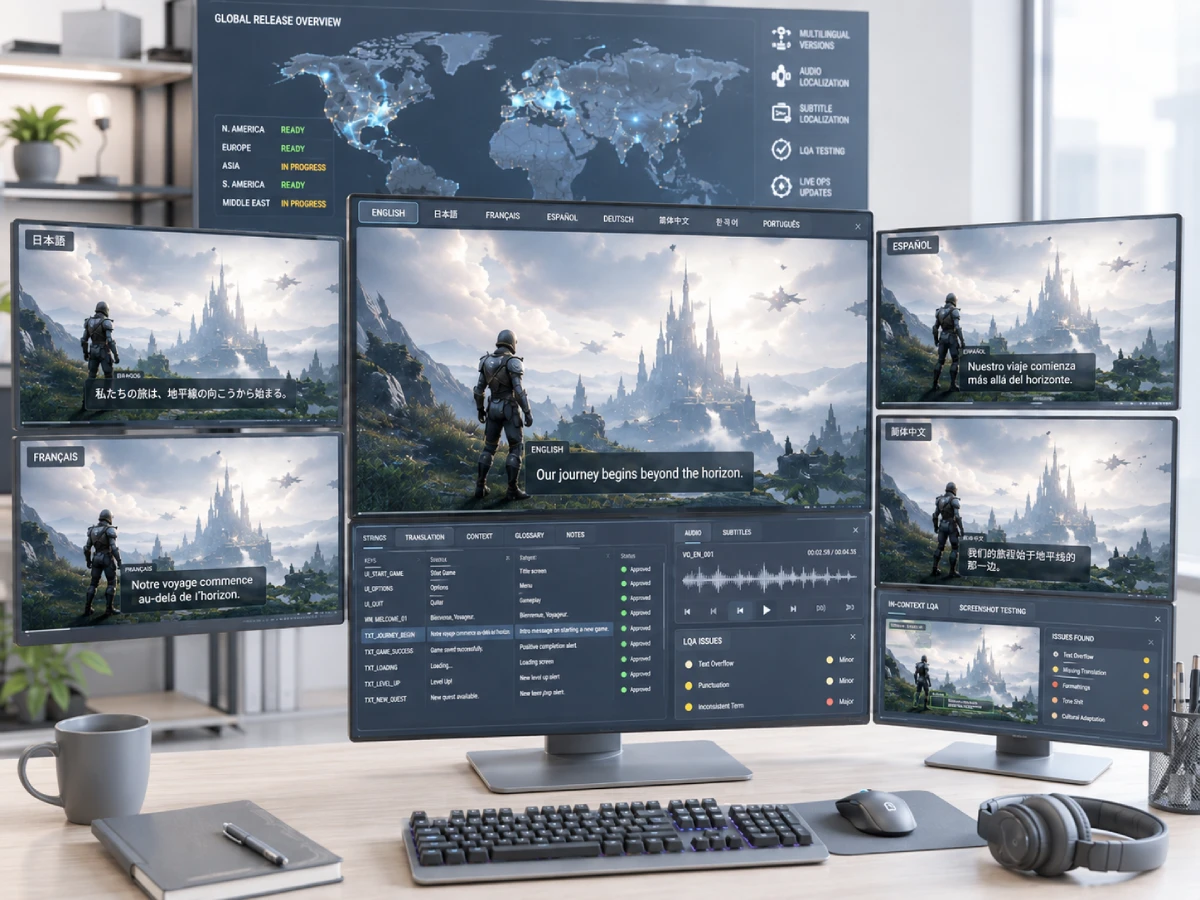
Professional video game localization workspace showing game UI strings, subtitle review, and multilingual project coordination
Built for Global ReleasesNew titles · Legacy games · DLC · Patches · Live operations

Textsprime provides end-to-end video game localization services combining content translation, cultural adaptation, technical file handling, audio and subtitle support, and in-game linguistic quality assurance. Workflows can support new releases, international versions of existing games, downloadable content, patches, and live-service updates.

01

End-to-End Game Localization

Projects can include content assessment, localization kit preparation, translation and cultural adaptation, editing, automated and human QA, audio and subtitle work, in-context LQA, final delivery, and language-asset maintenance.
02

Multilingual Game Launches

Shared glossaries, character references, style guidance, and coordinated testing help keep terminology, names, tone, and build versions aligned across languages for simultaneous global releases.

03

Continuous Localization for Updates

Approved terminology and translation memories can be reused across DLC, patches, seasonal events, new features, and live operations to improve update efficiency and reduce terminology drift.

Teams

Support for Developers, Publishers & Studios

Flexible game localization workflows support indie developers, mobile studios, AAA development and publishing teams, co-development and porting partners, and player-support or marketing departments.

Project Scope

One-Time & Ongoing Localization Projects

The service can cover a single script or store page, a complete game, a phased multilingual rollout, long-term updates, or high-volume recurring content.

Delivery

Global Online Project Delivery

Cloud-based project management supports secure remote file delivery, distributed team collaboration, version tracking, progress visibility, access control, and structured QA reporting.

Player Experience & Market Readiness

Why Game Localization Matters

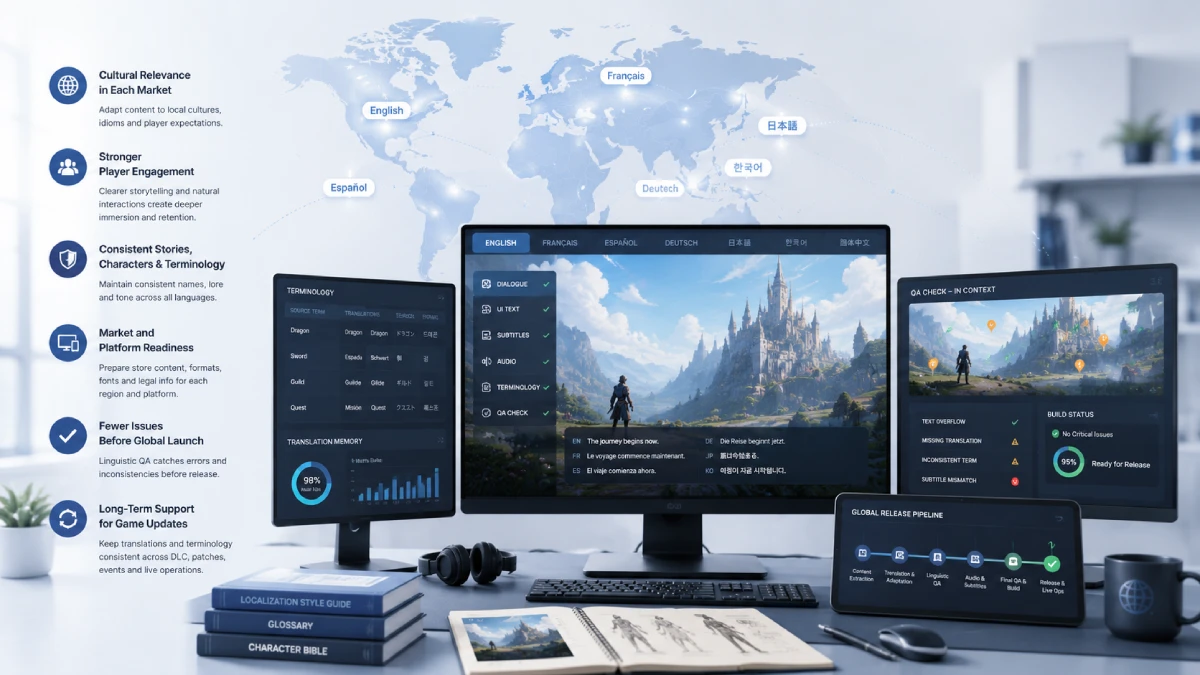
Localized video game interface with clear dialogue, menus, subtitles and player instructions
Core Player Outcome

A Native Experience for Every Player

Players should be able to follow the story, understand instructions and navigate the interface without feeling that they are using a translated version. Language, character voice, controls and UI terminology are adapted for the expectations of each target market.

  • Natural, character-appropriate dialogue
  • Clear tutorials and gameplay instructions
  • Readable menus, buttons and player prompts
  • Consistent player-facing terminology
01

Cultural Relevance in Each Market

Humor, idioms, cultural references, symbols and sensitive content are adapted for regional expectations while preserving the purpose of the original game.

02

Stronger Player Engagement

Clearer storytelling and more natural interactions reduce player friction, support retention and contribute to better community feedback.

03

Consistent Stories, Characters & Terminology

Character names, locations, skills, equipment, factions, mechanics, lore and tone remain aligned across all game content.

04

Market and Platform Readiness

Platform terminology, store content, regional formats, legal information, fonts and character support are prepared for each release market.

05

Fewer Issues Before Global Launch

Localization QA identifies truncation, missing translations, variable errors, contextual mistakes and audio-subtitle mismatches before release.

06

Long-Term Support for Game Updates

Translation memories, glossaries and approved language assets help keep DLC, patches, events and live-service updates consistent.

Understanding the Full Scope

What Is Game Localization?

Definition

More Than Translating Game Text

Game localization is the process of adapting a video game for the language, culture, technical environment and player expectations of a specific market.

It coordinates translated content with interfaces, graphics, audio, platform requirements and in-game testing so that the localized version remains clear, consistent and usable throughout the player experience.

Full Game Localization
LanguageCultureTechnologyVisualsAudioTesting

Translation is one part of the workflow. Complete localization brings all six layers together for the target release.

01

Language Translation & Cultural Adaptation

Storylines, dialogue and interface content are translated while humor, idioms, cultural references and market preferences are adapted without losing the original creative intent.

DialogueNarrativeHumorCultural references
02

Technical and Visual Adaptation

Localized content must work within character limits, fonts, glyphs, menus, buttons, graphics and platform resource files, including right-to-left language requirements.

Character limitsFonts and glyphsRTL layoutsPlatform files
03

Player-Facing Content Localization

Content used during play is localized for clarity, consistency and context so players can understand objectives, actions, rewards and system messages.

UI stringsQuests and itemsSkills and achievementsTutorials and help
04

Audio, UI & Art Asset Localization

Voice recordings, subtitles, interface elements and visual assets are coordinated so that timing, on-screen presentation and localized language remain aligned.

VoiceoverSubtitlesGraphic textAnimated and marketing assets
05

Market and Platform Requirements

Store terminology, legal and privacy information, age-rating content, regional formats and platform naming conventions are prepared for each intended market.

Store contentLegal and privacy textAge ratingsRegional formats
06

Localization for Launches, Updates & Live Operations

Localization continues after the initial release, supporting new features and recurring content while maintaining approved terminology, character voice and build consistency.

Initial releasesDLC and patchesEvents and charactersMaps and store updates
Service Scope Comparison

Game Translation vs. Full Game Localization

Language-Focused Scope

Game Translation

Game translation converts written or spoken game content from one language into another while preserving meaning, terminology and tone.

ScriptsDialogueUI stringsSubtitlesStore copy
Release-Ready Scope

Full Game Localization

Full game localization combines translation with cultural, technical, visual, audio and quality-assurance work to prepare the game for players in a specific market.

CultureUI layoutAudioGraphicsLQA
Scope Expansion

Translation becomes full localization when the project also requires:

Cultural Adaptation
Technical Integration
In-Context Testing
01

Primary Objective

Game Translation

Transfer the meaning of game text or audio into the target language accurately and naturally.

Full Game Localization

Adapt the complete player experience so the game works linguistically, culturally and technically in the target market.

02

Language & Narrative

Game Translation

Covers dialogue, scripts, descriptions, menus, tutorials, subtitles and other translatable content.

Full Game Localization

Also manages character voice, lore, names, humor, terminology and consistency across interconnected game assets.

03

Cultural Adaptation

Game Translation

May adjust wording where necessary, but normally remains focused on the supplied source-language content.

Full Game Localization

Reviews humor, references, symbols, imagery, sensitive content and regional expectations for the intended audience.

04

Technical & Visual Handling

Game Translation

Delivers translated strings or documents while preserving tags, variables and agreed file structures.

Full Game Localization

Also addresses text expansion, fonts, glyphs, UI constraints, right-to-left layouts, graphics and in-build presentation.

05

Audio & Multimedia

Game Translation

Can include translated voice scripts, subtitle files and transcription for later production.

Full Game Localization

Can coordinate voiceover, subtitle timing, recording assets, audio-text alignment and localized visual media.

06

Quality Assurance

Game Translation

Includes linguistic review, terminology checks and automated QA for the translated content.

Full Game Localization

Adds in-context LQA, functional checks, display review, audio-subtitle verification and regression testing support.

Choosing the Right Scope

The required service depends on how the content will be used.

Translation may be sufficient when

The project involves isolated content, internal reference material, early development scripts or assets that do not yet require market-specific integration and testing.

Full localization is recommended when

The game is being prepared for commercial release, platform submission, multilingual launch, voice production or an ongoing live-service market.

Complete Game Content Coverage

What Game Content We Localize

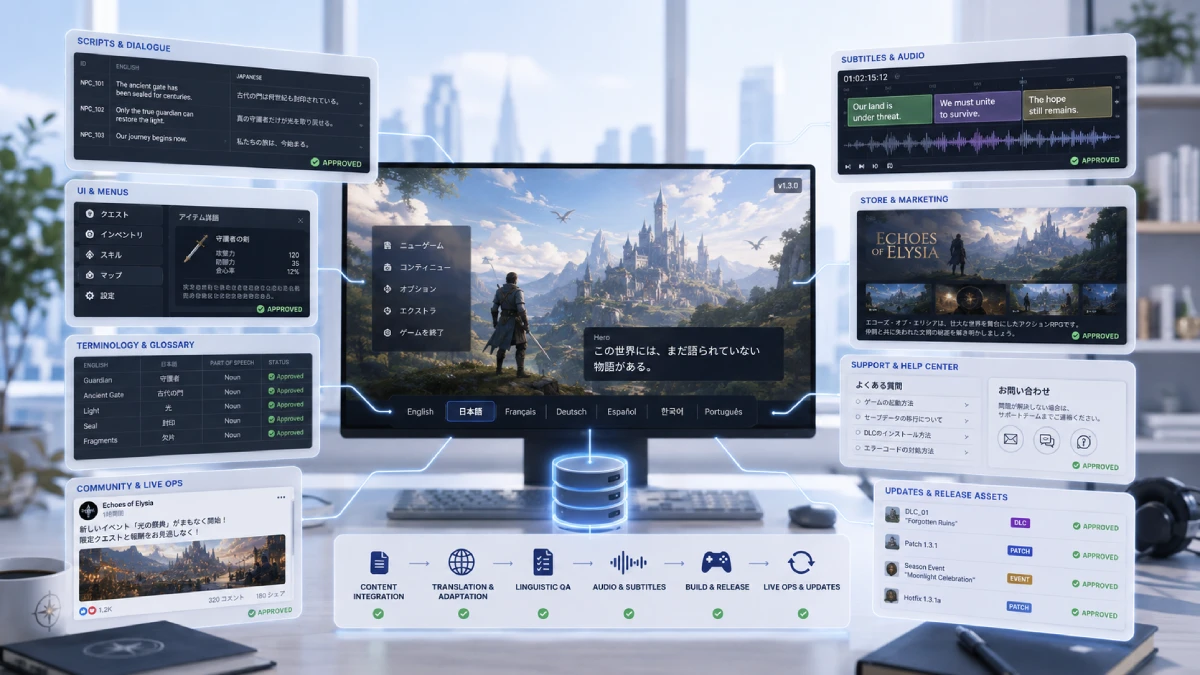
Game localization content workbench showing scripts, UI strings, subtitles, store content, marketing assets and audio materials
Connected Content Across the Game LifecycleFrom early scripts and interface strings to store updates, community content and legal assets.
Localization Content Library

Content organized by its role in the player journey

Each content stream can be localized independently or managed as part of one coordinated multilingual release.

Content Stream

In-Game Narrative

Narrative

Game Scripts & Dialogue

Main and side scripts, NPC conversations, cutscenes, character interactions and branching dialogue.

Gameplay Content

Quests, Items & Character Content

Quest names and descriptions, items, skills, classes, character attributes and profile information.

World-Building

Storylines, Lore & World-Building

World history, factions, locations, books, archives and narrative references that must remain consistent.

Content Stream

Interface & Gameplay

Interface

UI Strings, Menus & Tutorials

Menus, buttons, settings, tutorials, prompts, HUD content and short strings with limited display space.

Dynamic Messages

System Messages & Notifications

Error messages, network notices, system alerts, reward notifications and purchase confirmations.

Platform Content

Achievements, Trophies & Platform Strings

Achievement names, trophy descriptions, system prompts and platform-specific terminology.

Content Stream

Audio & Visual Media

On-Screen Language

Subtitles, Captions & On-Screen Text

Dialogue subtitles, cutscene subtitles, accessibility captions, screen text and timing information.

Recorded Content

Audio Scripts & Voiceover Content

Recording scripts, character voice lines, narration, battle speech, voice prompts and recording review.

Visual Assets

Graphics & Embedded Text

Text inside images, maps, signs, interface graphics, information graphics and other player-visible artwork.

Content Stream

Store & Player Outreach

Storefront

Store Pages & App Descriptions

Game titles, short and full descriptions, feature copy, update notes, search terms and store screenshots.

Promotion

Marketing & Promotional Materials

Advertising, trailer subtitles, press releases, social media, campaign pages and user-acquisition copy.

Player Relations

Community & Player Support Content

Community announcements, FAQs, customer-service replies, forum content, player help and knowledge bases.

Content Stream

Support & Compliance

Documentation

Help Guides, Manuals & ReadMe Files

Game instructions, operation guides, installation information, troubleshooting materials and update documentation.

Physical Release

Packaging, Logos & Game Boxes

Packaging text, boxed-game content, trademark notes, product information and market-specific presentation.

Legal Content

Legal, Privacy & Compliance Content

User agreements, privacy policies, terms of service, licenses, age-related notices and spending information.

In-Build Language Quality Assurance

Game Localization Testing & LQA Services

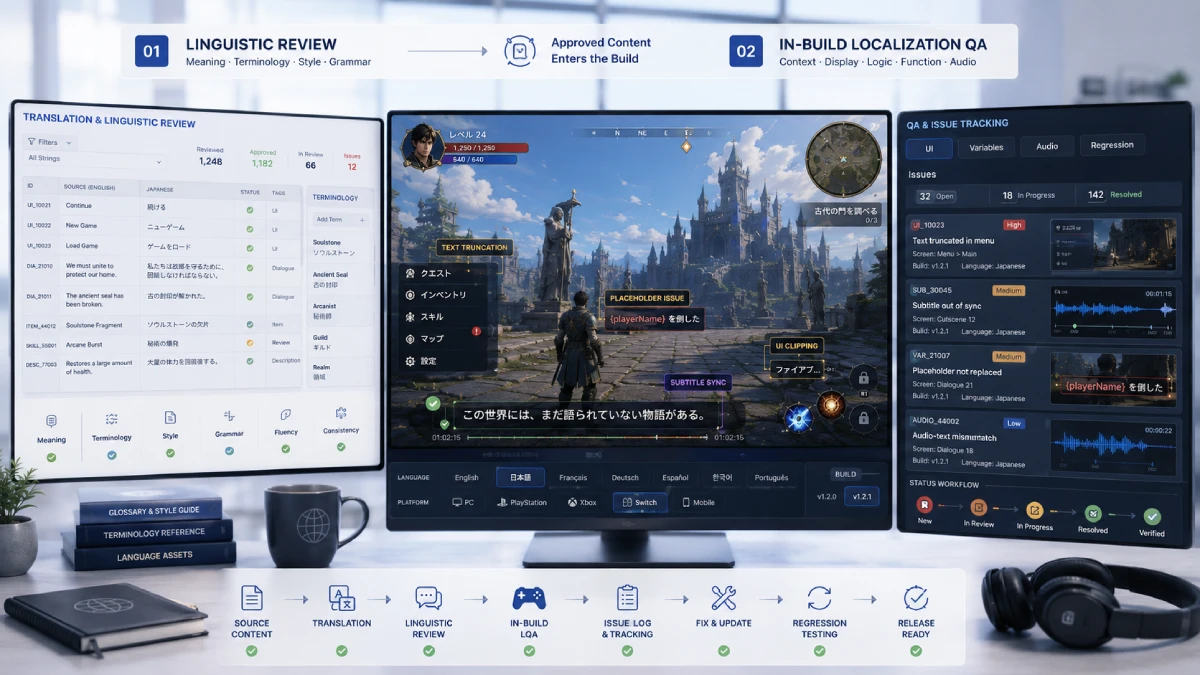
Game localization quality assurance testing showing localized interface review, text truncation, subtitle timing and bug reporting
Localized Build Under ReviewLanguage quality is checked in the same context players see during gameplay, menus, dialogues and supporting screens.
Current review focus
UIVariablesAudioRegression
UI & Display

Menus, HUD & Readability

Review interface fit, truncation, spacing, font display and player-facing clarity across screens.

Language Logic

Variables, Conditions & Context

Check placeholders, dynamic content, conditional language, gender, plural forms and scene-level accuracy.

Audio & Issue Tracking

Subtitle Sync & Defect Logging

Verify subtitle timing, audio-text alignment and create clear defect records with evidence for the team.

Plan

LQA Strategy & Test Planning

Define languages, platforms, devices, content scope, test cases, priorities, build access and regression requirements.

Test

In-Context Build Review

Review language, UI, variables, logic, audio, visual presentation and player understanding inside the agreed build.

Report

Bug Classification & Evidence

Record severity, defect type, screenshots, reproduction steps, language, platform and recommended correction.

Retest

Regression Testing & Verification

Confirm approved fixes, check affected areas and verify that old issues have not returned in a later build.

LQA Diagnostic Coverage

What We Check Inside a Localized Game Build

Test coverage is configured around the game, target languages, platforms, available builds and launch priorities.

01

In-Context Linguistic Testing

Meaning, tone, character voice and player-facing language are reviewed against the scene, gameplay logic and intended context.

MeaningToneCharacter voicePlayer clarity
02

UI, Truncation & Display Checks

Menus, buttons, dialogue boxes and HUD elements are checked for truncation, overflow, overlap, alignment and readability.

Text expansionFontsLine spacingButton space
03

Variables, Placeholders & Tags

Dynamic strings are tested for variable order, value replacement, player names, intact tags and correct separation of code and text.

VariablesPlayer namesTagsDynamic values
04

Gender, Plural & Conditional Logic

Testers verify plural forms, gender, grammatical cases, conditional text and sentence combinations generated by the game.

Plural formsGenderCasesConditions
05

Character & Terminology Consistency

Character names, items, skills, locations and approved terminology are checked across screens, files, builds and content versions.

CharactersItemsSkillsVersion consistency
06

Audio & Subtitle Verification

Voice lines and subtitles are checked for synchronization, timing, character match, asset naming, volume and content alignment.

Subtitle timingLip and scene syncVoice matchAudio assets
07
Extended Build Review

Functional & Compliance Testing

Localization-related functional issues, links, store content, legal notices and platform requirements can be checked within the agreed testing scope.

Localized functionalityLinksStore contentLegal noticesPlatform requirements
Bug Reporting

Actionable Defect Reports for Development Teams

Findings can be recorded in the agreed tracking system or report format so developers, localization teams and project managers can review and resolve issues efficiently.

SeverityDefect typeScreenshotReproduction stepsLanguagePlatformFix recommendation
Regression & Retesting

Verification After Fixes and Build Updates

Retesting confirms whether reported defects have been corrected and checks related screens, new content and updated builds for recurring or newly introduced localization issues.

  • Verify approved corrections
  • Check affected and related content
  • Review newly added localized assets
  • Prevent previously resolved issues from returning
Platforms, Scale & Release Models

Game Localization for Every Platform & Production Scale

Production Scale Coverage

Localization Workflows Configured Around the Way Your Game Is Built and Released

Projects can begin with a focused language scope, expand through staged releases or support large multilingual launches with audio, LQA, security and version-control requirements.

Focused & Flexible

Indie Game Localization

Flexible localization scopes help smaller development teams prioritize essential languages, control production stages and prepare content for regional or phased releases.

Priority languagesFlexible content scopeSmall-team communicationPhased release support
Project fitPrototypes · Early access · Small releases · Growing studios
Continuous Delivery

Live-Service & Multiplayer Games

Recurring workflows support events, seasons, community content, patches, player notifications and other high-frequency updates without losing approved terminology or narrative consistency.

Seasonal eventsPatches and updatesCommunity contentRapid notifications
Project fitMultiplayer games · Online services · Events · Ongoing content
Large-Scale Production

AAA Game Localization

High-volume projects can coordinate large scripts, parallel languages, multiple production teams, voice assets, in-build LQA and controlled delivery across complex release schedules.

Parallel languagesAudio productionMulti-team workflowsSecure version control
Project fitGlobal launches · Large scripts · Voiceover · Multi-build LQA
Platform Delivery Matrix

Localization Requirements Across Game Platforms

Each platform introduces different display limits, terminology, input methods, store requirements and testing conditions.

iOS & Android

Mobile Game Localization

Localization Focus

Mobile projects require concise UI language, controlled text expansion and clear player instructions across different screen sizes and device configurations.

Release Considerations
UI spaceApp storesEventsFrequent updatesMulti-device testing
Desktop Releases

PC Game Localization

Localization Focus

PC localization must remain usable across display settings, keyboard-based controls, platform stores and expandable content, including exported Unity and other engine-based language resources.

Release Considerations
Display settingsKeyboard terminologyPlatform storesDLCMods and community
Console Platforms

Console Game Localization

Localization Focus

Console content is adapted for platform terminology, controller prompts, trophies, system messages and the player-facing language used throughout the release.

Release Considerations
Controller promptsTrophiesSystem messagesPlatform terminologyReview requirements
Portable Devices

Handheld Game Localization

Localization Focus

Handheld releases require clear language within smaller interfaces, shorter display areas and device-specific control or input conditions.

Release Considerations
Small screensCharacter limitsInput methodsPortable display checks
Web-Based Delivery

Browser & Online Games

Localization Focus

Browser and online projects combine dynamic UI, account content, payment text and frequently changing web-based information that must remain clear across supported environments.

Release Considerations
Dynamic UIReal-time updatesAccount textPayment contentCross-browser display
Immersive Platforms

Virtual and Augmented Reality Games

Localization Focus

VR and AR localization must support spatial interfaces, subtitles within the player’s field of view, voice commands and immersive interactions without interrupting the experience.

Release Considerations
Spatial UIIn-view subtitlesVoice commandsImmersionDevice constraints
Coordinated Release Model

Cross-Platform Game Releases

Cross-platform localization keeps shared text, terminology and creative intent aligned while managing platform-specific strings, file branches, release schedules and testing requirements.

Shared terminologyPlatform-specific textBranch controlSynchronized launchMulti-platform LQA
Genre-Specific Language & Player Experience

Game Localization Services by Genre

Genre Localization Map

Different Games Require Different Localization Decisions

Genre affects narrative depth, terminology, interface density, character voice, update frequency and the way localized content must be tested inside the game.

Localization LensesApplied across every genre
Narrative & Voice
Terminology & Systems
Pace & Character Limits
UI & Player Guidance
In-Context LQA
Genre GroupNarrative Worlds
Action & Exploration

Action & Adventure Games

Localization must keep quests, combat prompts, cutscene dialogue and exploration content clear while preserving the pace and tone of the original experience.

Quest textCombat promptsCutscene dialogueExploration tone
Story-Rich Experiences

Role-Playing Games

RPG localization coordinates large narratives, branching dialogue, world-building, character identities and connected item and skill systems across the complete game.

Branching dialogueWorld-buildingCharacter voiceItems and skills
Genre GroupLive & Competitive Play
Persistent Online Worlds

MMORPG & Multiplayer Games

Persistent multiplayer projects require consistent skills, equipment and character interactions alongside community content, live events and frequent multilingual updates.

Community contentLive eventsSkills and equipmentFrequent updates
Fast Combat Experiences

Shooter Games

Shooter localization prioritizes concise instructions, accurate weapon terminology, natural battle voice lines and fast multiplayer notifications within strict display limits.

Weapon terminologyBattle voiceFast promptsCharacter limits
Genre GroupSystems, Rules & Competition
Complex Systems

Strategy & Simulation Games

These games depend on consistent system terminology, numbers, resources, rules and detailed tutorials that help players understand interconnected mechanics.

System terminologyResources and valuesComplex tutorialsRule clarity
Real-World Competition

Sports & Racing Games

Localization covers sport-specific terminology, commentary, vehicles, competitions, regional rules, measurements and units familiar to players in each market.

Sports terminologyCommentaryVehicles and eventsRegional units
Genre GroupFast-Access Play
Accessible Gameplay

Casual & Puzzle Games

Casual and puzzle games need short interface text, immediately understandable instructions and engaging language for store pages, events and reward content.

Short UISimple instructionsStore contentEvents and rewards
Rapid Player Feedback

Platformer & Arcade Games

Concise prompts, level information, rewards and repeated feedback must remain instantly readable during quick, movement-focused gameplay.

Level informationShort promptsRewardsRapid feedback
Genre GroupSpecialized Player Experiences
Learning-Focused Content

Educational Games

Educational localization aligns learning objectives, terminology and instructions with the target age group while considering regional curriculum and teaching differences.

Learning objectivesAge adaptationTerminology accuracyCurriculum context
Immersive Interaction

Virtual Reality Games

VR localization must keep spatial text, immersive subtitles and interaction instructions readable and comfortable within the player’s field of view.

Spatial textImmersive subtitlesInteraction guidanceVisual comfort
Shared Production Foundation

Genre Expertise Works Best with Controlled Language Assets

Approved terminology, character guidance, style decisions and build findings can be maintained across the project so each genre receives specialized treatment without losing overall consistency.

Genre-aware linguistsShared terminologyIn-context testing
Multilingual Voice, Dialogue & Timed Text

Game Audio, Voiceover & Subtitle Localization

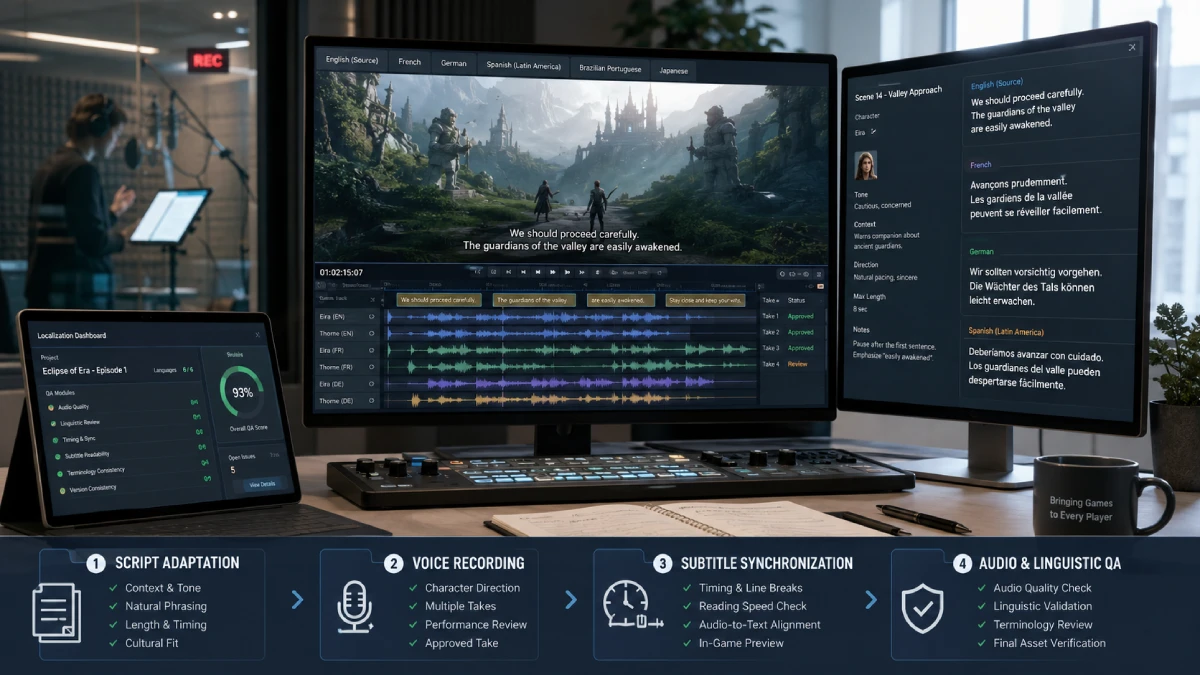
Professional game audio localization studio reviewing multilingual voiceover scripts, subtitle timing and recorded dialogue
Connected Audio ProductionVoice, subtitles and in-game presentation developed as one multilingual experience.
Audio Localization Scope

Services Across Voice, Subtitles and Multilingual Delivery

Individual services can support a focused production need or operate together within a complete game localization workflow.

Production Stage

Voice & Dialogue

Script Preparation

Audio Script Adaptation

Scripts are adapted for speakability, character tone, sentence length and culturally natural expression.

SpeakabilitySentence lengthCultural tone
Character Performance

Character Dialogue Localization

Dialogue reflects character identity, age, emotion, relationships and development throughout the story.

Character voiceEmotionNarrative continuity
Recording Production

Video Game Voiceover

Voiceover support may include casting coordination, scripts, performance guidance, recording and file organization.

Voice castingRecording directionMultilingual sessions
Production Stage

Subtitles & Synchronization

Timed Text

Subtitle & Caption Localization

Subtitles and captions are prepared around timecodes, line length, speaker identification and accessibility needs.

TimecodesLine breaksAccessibility
Scene Alignment

Timing & Synchronization

Audio and subtitles are aligned with dialogue length, animation, pauses, cutscenes and on-screen appearance.

Audio lengthScene timingAnimation rhythm
Player Readability

Character Limits & Reading Speed

Subtitle length, line count and reading speed are adjusted around platform space and spoken delivery.

Character limitsReading speedScreen space
Production Stage

Review & Delivery

Language Alignment

Audio and Subtitle Consistency

Names, terminology and character tone are checked across scripts, recordings, subtitles and content versions.

Names and termsCharacter toneVersion alignment
Production Review

Recording Review & Audio QA

Review may cover pronunciation, performance, missing recordings, file naming, technical quality and context.

PronunciationPerformanceTechnical quality
Controlled Delivery

Multilingual Audio Asset Management

Language, character, scene and version data are organized through consistent naming and update-ready delivery.

File namingLanguage versionsUpdate management
Integrated Game Localization

Audio Assets Remain Connected to the Wider Game Project

Voice and subtitle assets can be aligned with terminology, character guidance, UI text, cutscene content, build versions and in-game LQA.

TerminologyCharacter guidanceBuild versionsIn-game LQA
Localization Risks & Production Controls

Common Game Localization Challenges

Game Localization Risk Register

Localization Problems Often Begin Before Translation Starts

Missing context, technical constraints and uncontrolled content changes can affect language quality, interface usability and release readiness. Early controls help prevent these risks from spreading across languages and builds.

Where Risks EnterFour areas that shape localization quality
Source ContentContext, scripts and terminology
Language LogicVariables, grammar and cultural meaning
Build PresentationUI, audio and platform behavior
Release OperationsBranches, updates and multilingual launches
Risk Area

Context & Narrative

3 challenges

Limited Context & String Ambiguity

Production Risk

Isolated strings may support several meanings when the scene, speaker, action or player state is unknown.

Control Response

Provide screenshots, character IDs, scene notes and developer comments before linguistic decisions are finalized.

Humor, Slang & Cultural References

Production Risk

Literal translation can remove the intended effect, confuse players or introduce culturally unsuitable language.

Control Response

Adapt the function and tone of the content around the target audience rather than reproducing every source expression.

Character Voice & Narrative Consistency

Production Risk

Character personality, timelines and branching dialogue can drift when content is divided across linguists and versions.

Control Response

Maintain character profiles, narrative references, style rules and centralized review across the complete story.

Risk Area

Interface & Language Logic

3 challenges

UI Space and Character Limits

Production Risk

Text expansion can cause truncated buttons, crowded menus, unreadable HUD elements and problems on smaller screens.

Control Response

Define character limits, review font behavior and verify translated content inside representative screens and builds.

Variables, Gender & Plural Logic

Production Risk

Dynamic sentences can fail when variable order, gender, plural forms or grammatical cases differ between languages.

Control Response

Protect placeholders, document language rules and test generated sentence combinations inside the game environment.

Item, Skill & Feature Naming

Production Risk

Names must communicate game function, fit the interface and remain recognizable across related content and updates.

Control Response

Use approved naming conventions, length guidance and shared terminology assets across files, teams and versions.

Risk Area

Audio & Platform Delivery

2 challenges

Audio and Subtitle Synchronization

Production Risk

Voice lines and subtitles may not match scene timing, animation rhythm, pauses or available reading time.

Control Response

Coordinate scripts, timecodes and asset versions, followed by synchronization review and in-context audio LQA.

Platform-Specific Terminology

Production Risk

Controller buttons, system commands, trophies and store terminology may require different wording by platform.

Control Response

Apply platform terminology references, separate relevant strings and complete platform-specific linguistic checks.

Risk Area

Versions & Global Releases

2 challenges

Version Control & Frequent Updates

Production Risk

Multiple branches, hotfixes and changing strings can create outdated translations or mismatched multilingual assets.

Control Response

Track string IDs, builds and change status through controlled handoffs, version labels and reusable language assets.

Simultaneous Multilingual Releases

Production Risk

Parallel languages, shared deadlines and late source changes can produce uneven quality or delay the global launch.

Control Response

Coordinate shared terminology, synchronized QA, release calendars and clear content-freeze milestones.

Risk Reduction Foundation

Strong Controls Connect Language, Builds and Release Teams

Game localization risks are easier to manage when context, terminology, testing and version ownership are established before production accelerates.

Context packageTerminology & styleIn-build testingVersion discipline
A Controlled Partner for Global Game Releases

Why Choose Textsprime as Your Game Localization Company?

Game Localization Partner Framework

Capabilities That Support Quality from Source Files to Global Release

Textsprime combines game-experienced linguists, centralized production technology, human quality control and multilingual delivery support for launches, updates and live-service content.

230+Languages supported
800+Language pairs
Human-ReviewedFinal production responsibility
Project-BasedScope, schedule and pricing
Capability LayerSpecialist Resources & Governance

Game-Experienced Native Linguists

Projects are assigned to native-language linguists selected for gaming experience, genre familiarity, target-market knowledge and the ability to preserve character voice and narrative intent.

Native-language expertiseGenre knowledgeCharacter voice

ISO-Aligned Quality & Security Standards

Workflows apply ISO 9001 and ISO 17100 quality principles, together with ISO/IEC 27001-aligned information-security practices for structured review and controlled access.

Structured reviewQualified resourcesControlled access

Centralized Translation Management

A cloud-based translation management system coordinates files, contributors, terminology, reviews, QA findings, progress, versions and final delivery.

Cloud TMSProgress trackingVersion delivery
Capability LayerQuality & Language Control

AI-Enhanced, Human-Reviewed Production

AI and machine translation may support suitable repetitive, structured or high-volume content. Professional linguists remain responsible for context, terminology, tone, variables and final usability.

Selective AI useHuman reviewContext control

Professional LQA & In-Context Testing

Localized builds can be tested for meaning, character voice, UI display, variables, audio, player comprehension and regression issues, with defects recorded for correction.

Build testingDefect reportingRegression review

Terminology & Narrative Consistency

Glossaries, style guides, character profiles and translation memory help keep names, items, skills, lore and tone consistent across languages, branches and updates.

Game glossaryCharacter profilesTranslation memory
Capability LayerPlayer-Facing Localization Coverage

Audio, Subtitling & Voiceover Support

Support can cover audio scripts, voiceover coordination, subtitles, timecodes, recording review and audio QA as part of the wider localization workflow.

Audio scriptsVoiceoverSubtitle QA

Store Page & Marketing Localization

Store descriptions, search keywords, screenshots, promotional copy and social content are adapted for the target market while preserving the game’s positioning.

Store descriptionsPromotional copyMarket tone

Multi-Platform Project Support

Localization can be coordinated for mobile, PC, console, browser, handheld and VR releases, including platform-specific strings and terminology.

Mobile and PCConsole and browserHandheld and VR
Capability LayerDelivery, Security & Commercial Planning

Scalable Multilingual Delivery

Workflows can support one target language, coordinated multilingual launches, focused indie projects, large scripts, multilingual LQA and recurring updates.

Single languageGlobal releasesRecurring updates

Confidential & Secure Handling

Unreleased builds, storylines and character information are handled through secure transfer, controlled permissions, confidentiality obligations and project-level access.

Secure transferPermission controlConfidential content

Flexible Volumes & Fast Turnaround

Production can be configured for small content batches, large script volumes, parallel languages, phased milestones and time-sensitive update requirements.

Flexible volumesParallel languagesPhased delivery

Transparent Project-Based Pricing

Quotes are prepared after reviewing languages, content volume, platforms, LQA, audio, delivery formats and launch dates, avoiding inaccurate universal pricing.

Defined scopeDelivery milestonesClear project quote
Configured Around Your Release

One Localization Partner for Launches, Updates and Ongoing Content

The final workflow is selected around your languages, platforms, content types, testing scope, audio requirements, update frequency and release schedule.

New game launchesDLC & patchesLive-service updatesMultilingual LQAAudio & subtitles
Evidence-Based Agency Evaluation

How to Choose a Game Localization Agency

Agency Selection Framework

Start with Your Game Requirements, Not a List of Vendor Claims

The right agency should be able to connect its people, workflow, testing, technology and commercial proposal to your actual game, platforms, languages and release schedule.

Before Comparing AgenciesDefine the same project baseline for every proposal
Target languagesGame platformsContent volumeAudio requirementsLQA scopeRelease dates
First Filter

Project Relevance

Confirm that the agency understands your game, audience and player-facing content before reviewing production details.

4 criteria

Gaming Industry Experience

What to Check

Experience with similar genres, platforms, production models and release cycles—not only general translation work.

Evidence to Request

Relevant project examples and an explanation of how player experience influenced localization decisions.

Qualified Linguists & Reviewers

What to Check

Native-language ability, gaming familiarity, market knowledge and an independent linguistic review stage.

Evidence to Request

Resource-selection criteria, reviewer responsibilities and how linguists are briefed for the game.

Platform & Genre Support

What to Check

Ability to handle platform terminology, interface constraints, narrative depth and genre-specific player expectations.

Evidence to Request

How workflows differ for mobile, PC, console, multiplayer, browser, indie, AAA and VR projects.

Cultural Adaptation Expertise

What to Check

Understanding of humor, slang, cultural references, sensitive material and creative adaptation for the target audience.

Evidence to Request

How cultural decisions are researched, documented, reviewed and escalated for approval.

Second Filter

Production Proof

Validate how the agency controls language quality inside files, multimedia assets and playable builds.

3 criteria

In-Game LQA Capabilities

What to Check

Testing of language, UI display, variables, context, audio and player comprehension inside localized builds.

Evidence to Request

Sample defect reports, severity rules, device coverage, correction workflows and regression records.

Audio & Multimedia Services

What to Check

Coordination of audio scripts, voiceover, subtitles, timecodes, graphics, screenshots and video assets.

Evidence to Request

Recording-review responsibilities, synchronization procedures, multimedia QA and delivery specifications.

Technology & Language Assets

What to Check

Use of a controlled TMS, translation memory, terminology, automated QA and version tracking.

Evidence to Request

Ownership of language assets and protection of variables, placeholders, tags and approved terminology.

Third Filter

Operational Reliability

Determine whether the agency can protect confidential content, coordinate languages and support continuous releases.

3 criteria

Security & Confidentiality

What to Check

Secure handling of unreleased builds, storylines, character data, scripts and production files.

Evidence to Request

Access controls, NDA procedures, secure transfer, storage policies and resource offboarding.

Multilingual Project Scalability

What to Check

Ability to add languages without losing terminology control, review quality or schedule visibility.

Evidence to Request

Resource planning, shared language assets, multilingual LQA and synchronized release management.

Continuous Localization Support

What to Check

Processes for new strings, patches, events, DLC, hotfixes and recurring live-service updates.

Evidence to Request

Update intake, translation-memory reuse, terminology maintenance and new-build QA procedures.

Final Filter

Commercial Alignment

Compare proposals only after the participating agencies are working from the same confirmed project scope.

1 criterion
Proposal Review

Transparent Pricing & Delivery Planning

What a Useful Quote Should Define

Languages, word counts, platforms, content types, audio, LQA, formats, milestones, responsibilities and launch dates.

What to Compare

Inclusions, exclusions, assumptions, cost drivers, change handling, revision limits and final-delivery responsibilities.

Final Selection Principle

Choose the Agency That Can Show How Quality Will Be Produced

Clear evidence, defined responsibilities and a comparable scope are more useful than broad claims of being the “best” or “top” game localization company.

Relevant experienceQualified resourcesBuild-based LQASecure operationsComparable proposal
Regional Language Planning for Global Releases

Supported Languages & Game Markets

Market-Based Language Coverage

Build the Right Language Mix for Each Release

Language selection should reflect target players, platforms, writing systems and regional variants. Textsprime can support focused market launches or coordinated multilingual releases with shared terminology and quality control.

Single-market launchRegional language variantsMultilingual release
Regional Language Group

East Asian Game Markets

Localization shaped around writing systems, character voice, terminology and platform presentation.

Simplified & Traditional Chinese

Chinese Game Localization

Support for Mainland China, Taiwan and Hong Kong can address market-specific terminology, fonts, interface presentation and cultural differences.

Japan · Japanese-to-English

Japanese Game Localization

Japanese projects require careful handling of character tone, honorifics, text density and space-limited interface content.

South Korea

Korean Game Localization

Korean localization can cover game terminology, fonts, interface content, store pages and communication for player communities.

Regional Language Group

European Game Markets

European releases often require regional variants, text expansion control and platform-specific language.

France & Francophone Markets

French Game Localization

French localization considers text expansion, regional usage and appropriate language variants for France and other French-speaking markets.

Germany & German-Speaking Markets

German Game Localization

German content is reviewed for compound words, text expansion, interface space and platform-specific terminology.

Spain & Latin America

Spanish Game Localization

Spanish localization can be configured for European Spanish, Latin American Spanish and market-specific terminology or player-facing tone.

Regional Language Group

Southeast Asian & Arabic Markets

Regional programs may involve different scripts, mobile-first interfaces and culturally specific player expectations.

Thai · Vietnamese · Indonesian · Malay · Filipino

Southeast Asian Game Markets

Southeast Asian localization can coordinate regional terminology, font support and mobile-game content across multiple fast-growing player markets.

Middle East & Arabic-Speaking Markets

Arabic Game Localization

Arabic projects may require right-to-left layouts, font and glyph review, interface mirroring and culturally appropriate regional adaptation.

Regional Language Group

North America & Global Delivery

Market variants and shared production controls support regional releases and coordinated global launches.

United States & Canada

North American Game Markets

Coverage can include U.S. English, Canadian English and Canadian French, together with regional platform, store and marketing language.

Parallel Languages & Shared Versions

Coordinated Multilingual Launches

Parallel language teams can work from shared terminology, aligned content versions and synchronized LQA for a consistent global release.

Player-Facing Layout & Visual Localization

Desktop Publishing, UI Formatting & Layout Adaptation for Games

Game DTP & Interface Adaptation

Localized Content Must Fit the Interface, Not Just the Translation File

Game DTP extends beyond printed documents. It adapts user interfaces, embedded graphics, subtitles, store assets and other player-facing layouts so translated content remains readable, correctly directed and visually consistent.

Text Reflow

Adapt Content to Available Space

Resize, wrap and reposition localized text around interface dimensions and target-language length.

Script Support

Prepare Each Writing System

Review fonts, glyphs, encoding, text direction and mixed-script behavior for the target language.

Visual Verification

Check the Localized Output in Context

Inspect screens and exported assets for overflow, truncation, misalignment and missing visual content.

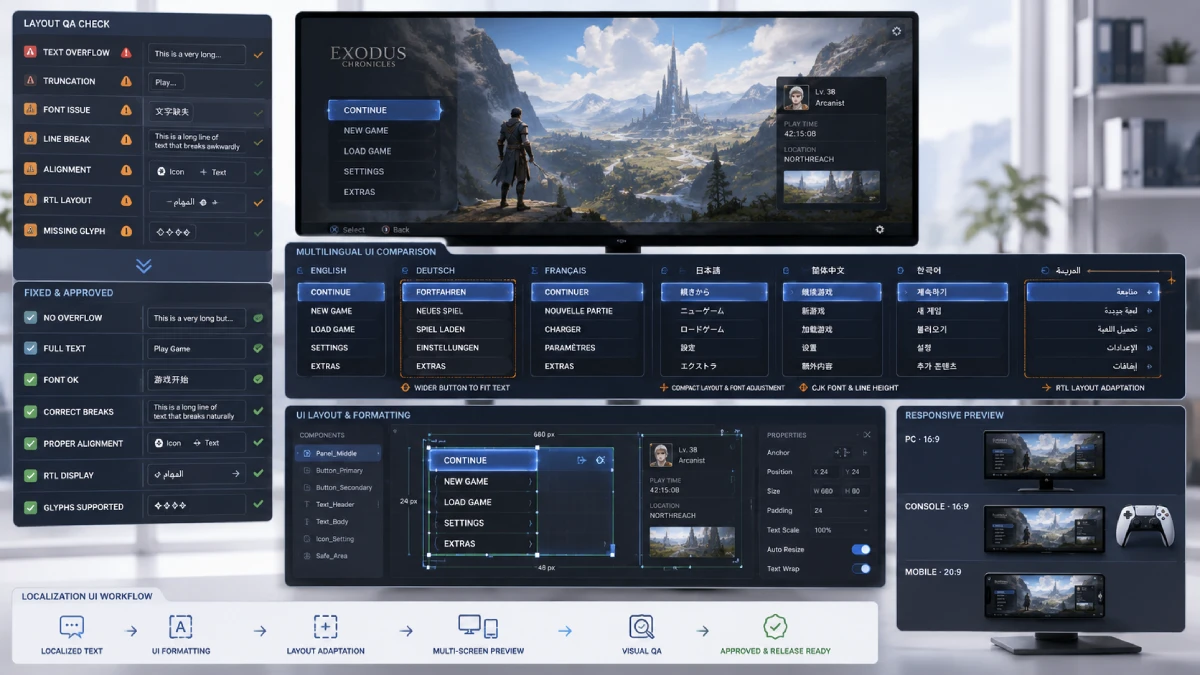
Professional game localization workspace reviewing multilingual user interface layouts, subtitles and visual game assets
Connected Visual ProductionUI, subtitles, graphics and store assets reviewed as one player-facing system.
Game Layout Production Canvas

Three Connected Stages of Game Layout Adaptation

Content is first fitted to the interface, then prepared for the target writing system and finally reviewed across localized visual assets.

Adaptation Stage 01

Reflow & Interface Fit

UI Layout & Text Expansion

Adjust buttons, menus, dialogue boxes, HUD elements and small-screen layouts as translated text expands or contracts.

Menus, Buttons & Tutorial Screens

Preserve control clarity, platform button terminology, readable wrapping and logical instructional flow.

Subtitles & On-Screen Text

Balance subtitle area, line count, font size, background treatment, timing space and scene readability.

Adaptation Stage 02

Script & Visual Assets

Fonts, Glyphs & Character Support

Check font coverage, missing glyphs, encoding, CJK display, Arabic shaping and required special symbols.

Right-to-Left Language Layouts

Adapt direction, alignment, numbers, icons, navigation and mixed-language display for right-to-left interfaces.

Graphics & Embedded Text

Replace or reconstruct localized text in signs, maps, textures, icons and other editable visual assets.

Adaptation Stage 03

Release Assets & Visual QA

Store Pages & Promotional Assets

Adapt descriptions, screenshots, banners, promotional graphics and video assets to market and platform needs.

Screenshot & Visual QA

Review localized screens for overflow, truncation, font problems, misalignment, missing graphics and direction errors.

Source Asset Quality & Final Results

Editable native files provide stronger layout control. Reconstruction and final visual similarity depend on the source files, fonts, layers and technical constraints.

Delivery Scope & Source Requirements

Layout Adaptation Supports Player-Facing Assets Without Assuming Direct Engine Modification

Textsprime can work with editable source assets, exported strings, screenshots and reference builds. Direct source-code or engine-project changes are not assumed unless specifically confirmed, and layout work aims to preserve hierarchy and usability rather than promise exact one-to-one reproduction.

Editable source filesExported game contentVisual QA referencesMultilingual output preparation
Project-Based Pricing & Delivery Planning

Game Localization Cost & Turnaround Time

A Scope-Based Project Estimate

Reliable Pricing Starts with the Actual Game Content and Release Plan

Game localization costs and schedules vary according to language volume, content complexity, platforms, audio, LQA and delivery requirements. Textsprime reviews the available files and production scope before preparing a project-based quote.

Estimate PreparationFour inputs needed before pricing and scheduling

Source files and content volume

Languages, markets and platforms

LQA, audio and visual requirements

Milestones and planned launch dates

Pricing Factors

What Affects Game Localization Cost?

The final price reflects the linguistic, technical and production resources required for the confirmed scope.

Content Volume & Language Scope

Source word count, target-language count, regional variants and the amount of player-facing content establish the core production volume.

Word countTarget languagesRegional variants

Game Type & Script Complexity

Narrative depth, branching dialogue, terminology density, character voice and genre-specific content affect resource selection and review effort.

Game genreScript complexityNarrative review

Technical & Visual Production

UI constraints, embedded graphics, file preparation, placeholders, platform files and layout adaptation may add technical production stages.

UI formattingGraphicsFile preparationPlatforms

Extended Services & Release Pressure

Voiceover, subtitles, in-game LQA, regression testing and compressed launch schedules require additional specialists, access and coordination.

AudioLQARegression testingLaunch date
Schedule Factors

What Affects Turnaround Time?

Delivery planning depends on production volume, dependencies, review access and the number of languages moving in parallel.

Content Volume & Language Count

Larger scripts, more target languages and parallel regional versions increase translation, review and coordination time.

Content volumeLanguagesParallel teams

Resource Availability & Context

Linguist availability, genre experience, screenshots, character information and developer notes influence how efficiently content can be understood and reviewed.

Linguist resourcesContextReference materials

Audio, LQA & Build Dependencies

Recording schedules, subtitle timing, device coverage, build access, defect correction and regression testing affect the production sequence.

Audio scheduleLQA accessBuild versionsRetesting

Feedback Cycles & Release Milestones

Client review, terminology approval, content freezes, revised builds and final launch dates must be reflected in the delivery plan.

Client feedbackVersion freezeMilestonesLaunch date
Quote Configuration

How a Game Localization Quote Is Prepared

A useful quote connects the confirmed content scope to the required workflow, schedule and deliverables.

Source Files

Strings, scripts, graphics, audio lists and reference builds.

Languages

Target markets, regional variants and release combinations.

Platforms

Mobile, PC, console, browser, handheld or VR requirements.

LQA Scope

Languages, devices, builds, test rounds and regression needs.

Audio Scope

Scripts, voiceover, subtitles, timing and recording QA.

Delivery Formats

Localized files, reports, visual assets and language resources.

Milestones

Content batches, review stages, builds and approval points.

Launch Dates

Regional deadlines, simultaneous releases and update windows.

Defined ScopeProduction WorkflowDelivery ScheduleProject-Based Quote
Scope Items That Change the Estimate

Production Requirements Beyond Basic Text Translation

These services may be included in the localization plan when they are required by the game, platform or release model.

Testing Scope

LQA & Testing Requirements

The estimate may account for test rounds, platforms, devices, target languages, build access, bug reporting and regression testing.

Test roundsDevicesBuild accessRegression
Multimedia Scope

Audio, Voiceover & Subtitle Requirements

Audio pricing and scheduling can include script preparation, casting, recording, subtitles, timecodes, synchronization and audio QA.

ScriptsVoice talentRecordingSubtitle QA
Language Assets

Translation Memory & Repeated Content

Repeated strings, approved legacy translations, terminology and translation memory may reduce repeated work and improve update efficiency.

Repeated stringsLegacy versionsTerminologyReusable translations
Global Release Scope

Multilingual & Simultaneous Releases

Parallel languages require coordinated teams, shared terminology, synchronized LQA, version management and aligned launch deadlines.

Multiple languagesParallel teamsSynchronized LQARelease coordination
Pricing Guidance

Why Fixed Public Pricing Is Not Recommended

Game projects differ significantly in content, language, technical preparation, LQA, audio and platform requirements. One universal rate may omit important production work or create an inaccurate comparison. File review provides a more reliable estimate before production begins.

Files reviewedScope confirmedSchedule plannedQuote prepared
Practical Answers for Game Localization Projects

Game Localization FAQs

Project Questions, Organized by Decision Stage

Review the Scope, Production Requirements and Delivery Model Before Localization Begins

Service Scope
Planning & Cost
Ongoing Delivery
Service Foundations

Scope & Service Model

Understand what game localization includes and how the service changes according to the project type and release requirements.

Game localization services prepare a game for players in another language or market. The scope may include translation, cultural adaptation, terminology management, UI formatting, subtitles, voiceover, store content, visual assets and in-game linguistic quality assurance.

Game translation converts written content into another language. Full game localization also considers cultural meaning, character voice, technical files, UI space, fonts, graphics, audio, platform requirements and testing inside the playable build.

LQA can be included when it is part of the confirmed project scope. For important releases, testing localized content inside the game build is recommended because file-based review alone may not reveal contextual, display, variable, audio or functional issues.

Yes. The workflow can be configured for mobile games, independent productions, large multilingual titles and other project types. Resource levels, languages, testing, audio and delivery stages are planned according to the content, platform, budget and release schedule.

Project Preparation

Quality, Planning & Cost

Review the common production risks, recommended practices and factors that influence a project-based estimate.

Common challenges include limited context, ambiguous strings, UI space, character limits, variables, plural and gender logic, cultural references, narrative consistency, audio timing, version control and coordination across several languages and release builds.

Plan localization early, provide screenshots and developer context, prepare an approved glossary and style guide, protect variables and placeholders, test localized builds and maintain translation memory, terminology and version records for future updates.

Cost depends on the source volume, target languages, game and script complexity, platforms, UI and graphics, audio, required review level, LQA scope and launch schedule. A project-based quote is prepared after the files and requirements are reviewed.

Delivery Operations

Technology, Security & Ongoing Releases

Understand how AI-assisted workflows, confidential files, continuous updates and multilingual releases can be managed.

AI-assisted translation may be used for suitable repetitive or high-volume content when it supports the agreed workflow. The output is reviewed by professional linguists before delivery. Creative, narrative, character-driven or sensitive content can use a fully human workflow.

Confidential materials can be handled through secure file transfer, controlled project access, confidentiality obligations and documented resource permissions. ISO/IEC 27001-aligned information-security practices can also support the handling of unreleased builds, stories and character information.

Yes. Continuous localization can support DLC, patches, seasons, events, live-service content and recurring store or community updates. Translation memory, terminology and project records help new content remain consistent with previously approved releases.

Projects can cover major global languages, regional variants and coordinated multilingual releases across Asian, European, Middle Eastern and North American game markets. Language-pair availability and the required regional version are confirmed during project planning.

Project-Specific Confirmation

Final workflow, pricing, schedule, LQA coverage and delivery details are confirmed after the game files and release requirements are reviewed.